



When a hurricane tears through a coastal city or a wildfire forces thousands from their homes, the first hours are defined by logistics. Food, clean water, and shelter become the immediate priorities — and the vehicles that deliver them are often the difference between a coordinated response and a humanitarian crisis. Disaster response vehicles, including mobile field kitchens and water distribution units, have evolved from improvised solutions into precision-engineered platforms built to perform under the most demanding conditions imaginable. Understanding what makes these vehicles effective — and who builds them — is essential for emergency management agencies, NGOs, and government procurement teams.
Why Specialized Vehicles Are Central to Disaster Response
Conventional supply chains collapse during major disasters. Roads are blocked, warehouses are inaccessible, and commercial food service infrastructure is either damaged or overwhelmed. Mobile response vehicles exist precisely to bypass these failures. They carry their own power generation, water storage, cooking capacity, and sometimes refrigeration — functioning as self-contained operational units that can be deployed within hours of a disaster declaration.
The design requirements for these vehicles are far more complex than they might appear. A mobile field kitchen, for example, must comply with food safety regulations, withstand rough terrain, operate in extreme temperatures, and serve hundreds or thousands of meals per day. A mobile water unit must filter, purify, and distribute potable water at scale while remaining compact enough to navigate debris-strewn roads. These are not off-the-shelf products — they are custom-engineered solutions that require deep expertise in both vehicle fabrication and operational field requirements.
The Engineering Behind Mobile Field Kitchens
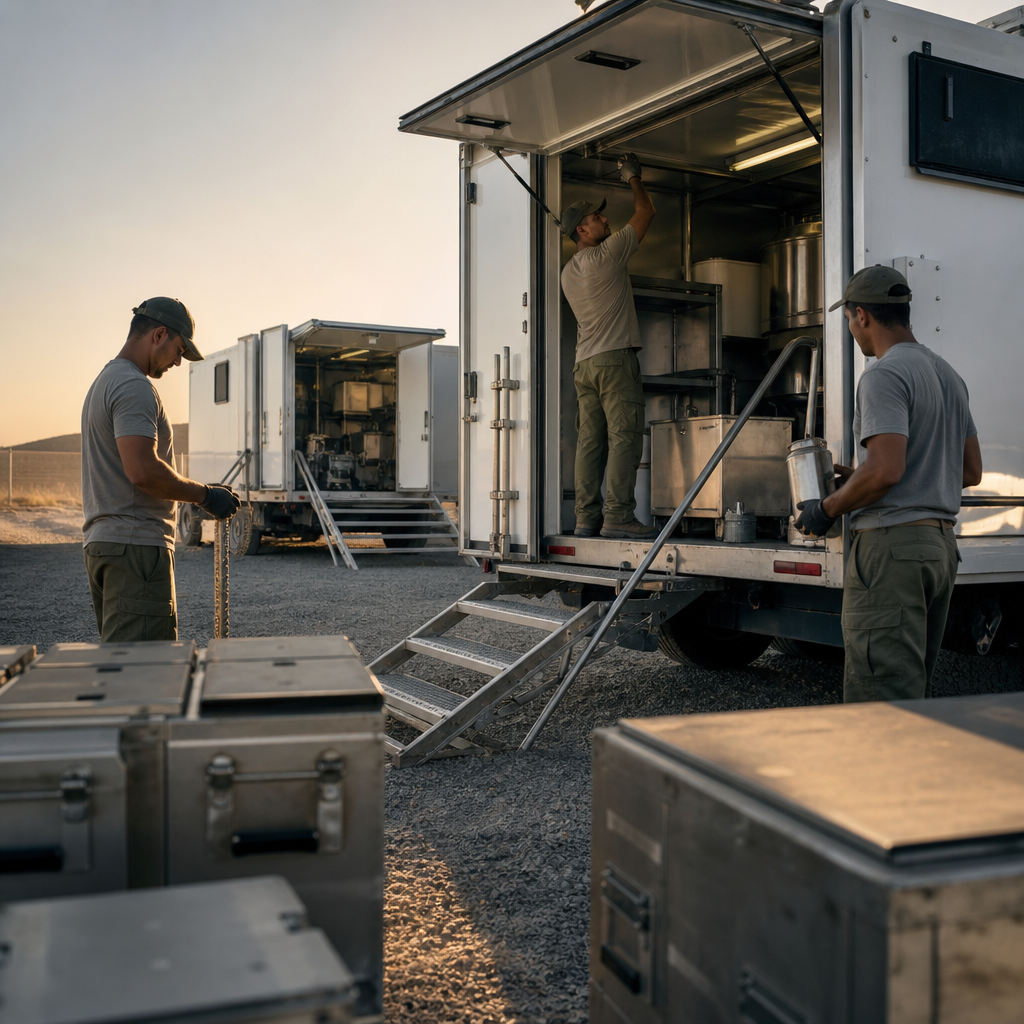
Modern mobile field kitchens are built on heavy-duty truck or trailer platforms and equipped with commercial-grade cooking appliances, ventilation systems, stainless steel work surfaces, and integrated water supply. The best units can produce 1,500 to 5,000 meals per day, depending on configuration. They are designed to be operated by small crews, often with minimal setup time — a critical factor when response teams are already stretched thin.
Key Design Considerations for Field Kitchen Vehicles
Thermal management is one of the most overlooked challenges in field kitchen design. Cooking at high volume generates enormous heat, and without proper insulation and ventilation, crew safety and food quality are both compromised. Structural integrity is equally important — these vehicles must survive transport over damaged roads and still function reliably upon arrival. Fuel flexibility, the ability to run on propane, diesel, or natural gas depending on what is available in the field, is another feature that separates purpose-built disaster response kitchens from repurposed commercial units.
Mobile Water Units: Delivering the Most Critical Resource
Access to clean drinking water is the single most urgent need in the aftermath of floods, earthquakes, and infrastructure failures. Mobile water units range from simple tanker trucks to sophisticated filtration and purification systems capable of processing thousands of gallons per hour from contaminated sources. Advanced units incorporate reverse osmosis technology, UV sterilization, and real-time water quality monitoring — all packaged into a vehicle that can be driven to a disaster zone and operational within minutes of arrival.
Scalability and Interoperability in Water Distribution
Effective disaster water response requires more than a single vehicle — it requires a coordinated fleet that can scale to meet evolving needs. Procurement teams increasingly look for modular designs that allow water units to be connected in series, expanding capacity as the scope of a disaster becomes clearer. Interoperability with existing emergency management infrastructure, including standardized fittings, communication systems, and power interfaces, is now a baseline expectation rather than a premium feature.
Project Management: The Hidden Factor in Successful Deployments
Building and deploying disaster response vehicles is as much a project management challenge as it is an engineering one. Agencies that have navigated large-scale vehicle procurement know that timelines, compliance requirements, and coordination between multiple stakeholders can derail even the best-designed programs. Hiring project managers who actually deliver is a critical success factor — particularly when contracts involve custom fabrication, phased delivery schedules, and regulatory approvals that must be managed simultaneously. The difference between a vehicle fleet that arrives on time and one that sits in production limbo often comes down to the quality of project oversight on both the client and manufacturer side.
Craftsmen Industries: A Trusted Name in Custom Vehicle Fabrication
Craftsmen Industries has built a strong reputation in the custom vehicle fabrication space, delivering specialized mobile units for a wide range of applications including disaster response, military support, and government operations. Their engineering teams work closely with clients to develop vehicles that meet precise operational specifications — from mobile command centers to field kitchens and water distribution platforms. With decades of experience in custom fabrication, Craftsmen Industries brings both technical depth and production reliability to programs where failure is not an option.
What Sets Purpose-Built Fabricators Apart
The distinction between a general-purpose vehicle modifier and a purpose-built fabricator is significant. Purpose-built fabricators like Craftsmen Industries invest in understanding the operational environment their vehicles will enter — not just the mechanical specifications. This means engaging with end users, field commanders, and logistics coordinators during the design phase to ensure that every element of the vehicle, from door placement to power outlet configuration, reflects real-world use cases. The result is a vehicle that performs as intended from day one, rather than one that requires costly field modifications after delivery.
Training, Exercises, and Industry Events
Procurement and deployment of disaster response vehicles does not happen in isolation. Emergency management professionals rely on industry events, training exercises, and knowledge-sharing forums to stay current on best practices and emerging technologies. Platforms that connect emergency management professionals with relevant disaster response and emergency management events play an important role in helping agencies evaluate new vehicle technologies, meet fabricators, and benchmark their programs against peer organizations. Staying engaged with the broader emergency management community is essential for agencies that want to make informed procurement decisions.
Conclusion: Investing in the Right Infrastructure Before the Next Disaster
The time to evaluate, procure, and deploy disaster response vehicles is before a crisis occurs — not during one. Mobile field kitchens, water distribution units, and other specialized response platforms require lead time to design, fabricate, and test. Agencies that treat these vehicles as afterthoughts consistently find themselves underprepared when disaster strikes. Those that invest in purpose-built, professionally managed vehicle programs are able to respond faster, serve more people, and operate more safely under pressure.
Whether you represent a federal emergency management agency, a state-level disaster response organization, or an international NGO, the message is consistent: the quality of your mobile infrastructure determines the quality of your response. Partnering with experienced fabricators, hiring capable project managers, and staying connected to the broader emergency management community are the foundational steps toward building a response capability that holds up when it matters most.
