



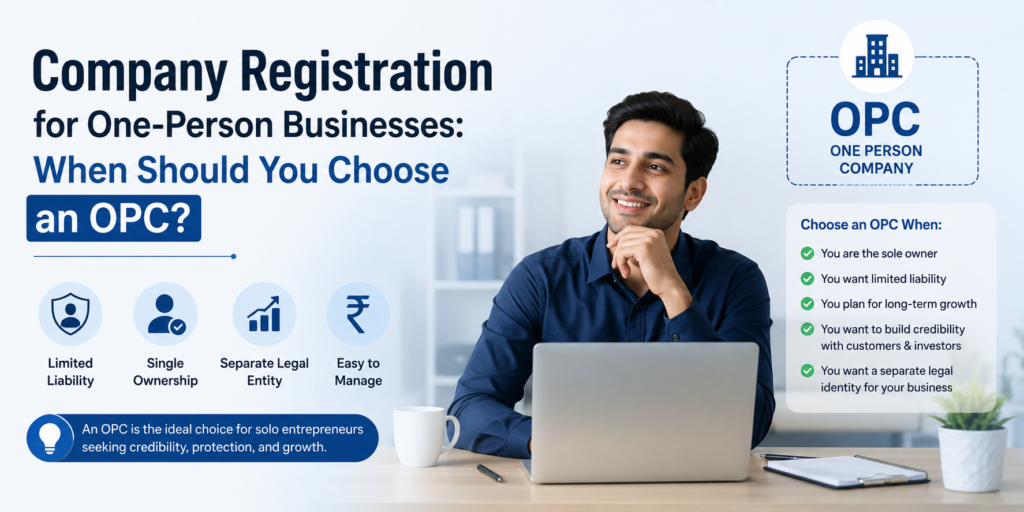
Not every founder starts with a co-founder. A large share of India’s businesses, freelancers turned consultants, single-owner service providers, solo e-commerce sellers, are built by one person. For years, these entrepreneurs had only two real choices: stay in an unregistered sole proprietorship with unlimited personal liability, or bring in a second shareholder just to satisfy the Companies Act’s minimum requirement for a Private Limited Company.
The One Person Company (OPC), introduced under the Companies Act, 2013, closed that gap. Through OPC registration, a single individual can establish a company with limited liability and a separate legal identity without needing a co-founder or completing a full private limited company registration. However, an OPC isn’t automatically the right choice for every solo entrepreneur, it comes with its own restrictions on fundraising, scalability, and eventual conversion to a Private Limited Company.
What is a One Person Company (OPC)?
A One Person Company (OPC) is a company incorporated under the Companies Act, 2013, with only one member, who acts as both the sole shareholder and (in most cases) the sole director. Through OPC registration, founders can combine the limited liability protection of a private limited company with the simplicity of single ownership.
Did You Know? India is among the few countries that offer a dedicated single-owner corporate structure with limited liability. Most jurisdictions require solo entrepreneurs to either operate as a sole proprietorship (unlimited liability) or bring in at least one additional shareholder for a company.
OPC vs. other business structures
| Feature | OPC | Sole Proprietorship | Private Limited Company |
| Minimum members | 1 (with 1 mandatory nominee) | 1 | 2 shareholders, 2 directors |
| Liability | Limited to share capital | Unlimited (personal assets at risk) | Limited to share capital |
| Legal identity | Separate legal entity | No separate identity | Separate legal entity |
| Fundraising (equity/VC) | Not practical | Not possible | Best suited |
| DPIIT/Startup India eligible | No | No | Yes |
| Compliance burden | Moderate | Low | High |
| Annual filings | Mandatory (ROC) | Not applicable | Mandatory (ROC) |
| Conversion required on growth | No (voluntary only) | N/A | N/A |
| Best suited for | Solo founders wanting limited liability without a co-founder | Very small, low-risk local businesses | Startups planning to raise funds or scale with a team |
Who is Eligible to Register an OPC Registration?
To incorporate an OPC in India, the following conditions under the Companies Act, 2013, and the Companies (Incorporation) Rules must be met:
- Only a natural person who is an Indian citizen can be a member or nominee of an OPC (not a company, LLP, or trust).
- Following the Companies (Incorporation) Second Amendment Rules, 2021, the residency requirement for the sole member/nominee was relaxed, a person must have stayed in India for at least 120 days in the immediately preceding financial year (reduced from 182 days) to qualify.
- NRIs are now permitted to incorporate an OPC, a change introduced by the 2021 amendment that previously restricted OPC formation to resident Indians only.
- A nominee must be appointed at the time of incorporation, who will take over the OPC’s membership in the event of the sole member’s death or incapacity.
- An individual can be a member of only one OPC at a time.
- Minors cannot be members or nominees of an OPC.
- Certain regulated activities, such as banking, insurance, and Non-Banking Financial Company (NBFC) business, cannot be carried out through an OPC structure.
Common Mistake: Founders sometimes assume any family member can be added as a nominee without consent. In reality, the nominee must give written consent (Form INC-3) before incorporation, and this consent can be withdrawn later, founders should choose nominees who genuinely understand and accept this future responsibility.
How to Register an OPC: Step-by-Step Process
OPC incorporation follows largely the same SPICe+ framework used for Private Limited Companies on the MCA V3 portal, with a few OPC-specific additions, primarily the nominee appointment.
Documents Required Checklist
For the sole member/director:
- PAN card and Aadhaar card
- Identity proof (Passport/Voter ID/Driving Licence)
- Address proof, bank statement or utility bill not older than 2 months
- Passport-size photograph
- Digital Signature Certificate (DSC), Class 3
For the nominee:
- PAN and Aadhaar
- Written consent in Form INC-3
- Identity and address proof
For the registered office:
- Proof of registered office (rent agreement/sale deed)
- No Objection Certificate (NOC) from the property owner
- Latest utility bill
The registration process
- Obtain a Digital Signature Certificate (DSC) for the sole member.
- Reserve the company name via SPICe+ Part A on the MCA V3 portal. OPC names must include (OPC) Private Limited as a suffix.
- Obtain nominee consent in Form INC-3 and keep it ready for upload.
- File SPICe+ Part B, including the sole director’s DIN application, along with linked forms, e-MOA (INC-33), e-AOA (INC-34), and AGILE-PRO-S for PAN, TAN, GST, and other registrations.
- Pay applicable fees, government incorporation fee (nil for authorised capital up to ₹15 lakh), state stamp duty, and professional certification charges.
- ROC verification and approval, resulting in the Certificate of Incorporation.
Timeline and Cost
| Stage | Typical Timeframe |
| DSC issuance | 1–2 working days |
| Name reservation (Part A) | 1–2 working days |
| SPICe+ Part B processing | 4–8 working days |
| Total (well-prepared filing) | 7–15 working days |
Total costs, including professional fees, DSC issuance, and state-specific stamp duty, typically range from roughly ₹8, 000 to ₹18, 000 or more, depending on the state and the extent of professional assistance used.
Benefits of Choosing an OPC
- Limited liability, your personal assets remain protected, unlike a sole proprietorship
- Separate legal identity, the OPC can own property, sign contracts, and operate a bank account in its own name
- Full control, no need to consult co-shareholders on business decisions
- Perpetual succession, the nominee ensures business continuity if the sole member is unable to continue
- Easier compliance than a Private Limited Company, certain relaxations apply, such as exemption from holding an Annual General Meeting (AGM) in specific cases
- Greater credibility than a proprietorship when dealing with vendors, banks, and larger clients
Limitations of an OPC
- Cannot raise equity funding the way a Private Limited Company can, since it has only one shareholder by design, most VCs and angel investors avoid this structure
- Not eligible for DPIIT/Startup India recognition, which is limited to Private Limited Companies, LLPs, registered partnership firms, and cooperative societies
- Cannot add more shareholders without converting into a Private Limited Company first
- Restricted from certain regulated sectors, including banking, insurance, and NBFC activities
- One person, one OPC rule, an individual cannot simultaneously be the sole member of more than one OPC
- Ongoing compliance burden, while lighter than a Private Limited Company, an OPC still requires annual ROC filings, board resolutions, and statutory registers, which is more than a sole proprietorship requires
When Should You Convert an OPC to a Private Limited Company?
Is OPC-to-Pvt Ltd conversion mandatory once turnover crosses a limit?
NO. Under the older rules, an OPC was required to mandatorily convert into a Private Limited or Public Limited Company if its paid-up capital exceeded ₹50 lakh or its average annual turnover over three consecutive years exceeded ₹2 crore. However, the Companies (Incorporation) Second Amendment Rules, 2021 removed this mandatory conversion requirement altogether. As of 2026, an OPC that crosses these thresholds can legally continue operating as an OPC, conversion is no longer compulsory.
So what do the ₹50 lakh and ₹2 crore figures mean today?
These thresholds are no longer conversion triggers, they now matter for a different reason: early voluntary conversion eligibility. Normally, an OPC must complete two years from incorporation before it can voluntarily convert into a Private Limited Company. But if the OPC’s paid-up capital exceeds ₹50 lakh or its average turnover exceeds ₹2 crore before those two years are up, it becomes eligible to convert earlier, should the founder choose to.
Latest News: The 2021 amendment also removed the earlier two-year lock-in that once barred an OPC from voluntarily converting to a Private Limited Company at all during its first two years, except on breaching the financial thresholds. Founders today can convert voluntarily, at any time after two years, purely as a business decision, with no financial trigger required.
Common reasons founders convert an OPC voluntarily
- Bringing on a co-founder or investor and needing to issue shares
- Wanting to apply for DPIIT/Startup India recognition
- Planning to raise institutional or venture capital funding
- Needing to expand the board with additional directors for governance or credibility reasons
How conversion works
- Complete two years from incorporation, or meet the early-eligibility financial thresholds.
- Appoint at least one additional director and bring in at least one additional shareholder, since a Private Limited Company requires a minimum of two of each.
- Alter the MOA and AOA to reflect the new structure.
- File the required forms, including Form INC-6, with the Registrar of Companies.
Important: GST registration thresholds are entirely separate from OPC conversion rules. An OPC must register for GST once it crosses ₹40 lakh in turnover (for goods, in most states) or ₹20 lakh (for services), or immediately, if it sells through e-commerce platforms or makes interstate supplies, regardless of whether it converts to a Private Limited Company.
OPC vs. Sole Proprietorship vs. Private Limited: A Quick Decision Guide
| Business Need | Recommended Business Structure |
| Run a very small, low-risk local business and want minimal compliance | Sole Proprietorship |
| Want limited liability and a company identity, but are working solo with no immediate plans to raise funding | OPC |
| Plan to bring in co-founders, raise VC/angel funding, or apply for DPIIT recognition | Private Limited Company |
| Provide professional services with steady, self-funded growth and a partner | LLP |
Conclusion
An OPC is a purpose-built solution for solo entrepreneurs who want the protection of limited liability and a separate legal identity without the complexity of finding a co-founder. It’s a meaningful upgrade from a sole proprietorship, offering credibility, continuity through a nominee, and easier compliance than a full Private Limited Company. But it’s not designed for scale, the structure isn’t suited to equity fundraising or DPIIT recognition, and it caps out at one shareholder by design.
The good news is that the path forward isn’t a dead end: since the 2021 amendment, converting an OPC into a Private Limited Company is entirely voluntary and can be done whenever your business, and your ambitions, are ready to grow. The key is choosing the right structure for where you are today, with a clear-eyed view of where you want the business to go.
Why Choose Zolvit
- Expert lawyers, CAs, and Company Secretaries to guide your OPC registration and future conversion
- Fast processing, from DSC issuance to Certificate of Incorporation
- Affordable, transparent pricing with no hidden charges
- End-to-end compliance support, annual ROC filings, nominee management, and OPC-to-Pvt Ltd conversion when you’re ready
- Dedicated support to help you choose the right structure for your business stage
FAQs
1. Can one person start both an OPC and a sole proprietorship?
YES. There is no legal bar on an individual owning a sole proprietorship alongside a One Person Company. However, the same person cannot be the sole member of more than one OPC at the same time.
2. Is an OPC required to hold an Annual General Meeting (AGM)?
NO. An OPC is generally exempt from mandatorily holding an AGM, since it has only one member. It must still comply with other statutory requirements, such as maintaining registers and filing annual returns with the ROC.
3. Can an NRI register a One Person Company in India?
YES. Following the Companies (Incorporation) Second Amendment Rules, 2021, NRIs are permitted to incorporate an OPC, provided they meet the applicable residency and documentation requirements under the amended rules.
4. Does crossing ₹2 crore turnover force an OPC to convert?
NO. Since the 2021 amendment, exceeding ₹2 crore turnover or ₹50 lakh paid-up capital no longer triggers mandatory conversion. An OPC can continue operating as-is; these thresholds now only affect eligibility for early voluntary conversion.
5. Can an OPC raise funding from investors?
NO, not in its current form. Since an OPC has only one shareholder by structure, it cannot issue equity to multiple investors. Founders seeking equity funding typically convert to a Private Limited Company first.
